Skill Acquisition, Learning, and Passive Knowledge

The goal of this article is to share and lay out for you the tools and mental frameworks that I'm using to:
Understand my own personality
Figure out what I want out of life
Determine how to get there
I believe that everyone has their own way and path in life. There is no "best" path because everyone has different goals and different ways to get to those goals.
Some people want fulfillment, some want fame, some want fortune, some (probably many) don't know what they want yet.
Even if you want the same thing as someone else, your optimal path to get there differs tremendously.
You can read more on what I think about advice and decision making
, but fundamentally the lesson comes down to this:
Because your situation is so unique, you have to be the one to craft your path and make your own decisions (consciously or not) if you want to get anywhere interesting in life, at all, ever.
My goal is not to tell you what to do. I'm not your mommy or your psuedo-influencer-father figure.
I'm sharing what has worked for me in a generalized format that many people can adapt and utilize in their own lives.
Skill Acquisition and Lateral Achievement
Acquiring skills is important in and of itself. There is some subset of “soft-skills” that is required to learn anything at all, and that is why learning any skills at all make learning other skills significantly easier.
Having the consistency and dedication to get to the last level in a difficult video game correlates highly with the skill of getting to the top tiers of business, because you add different modalities of life into your repertoire.
By reaching the top tiers of any domain, you are guaranteed a set of universal experiences:
You experience what “hard” feels like.
You experience what accomplishment feels like.
You experience what it means to truly go “all-in.”
You experience what failure feels like.
This is the essence of lateral achievement. Achievement in one domain makes achievement in other domains easier.
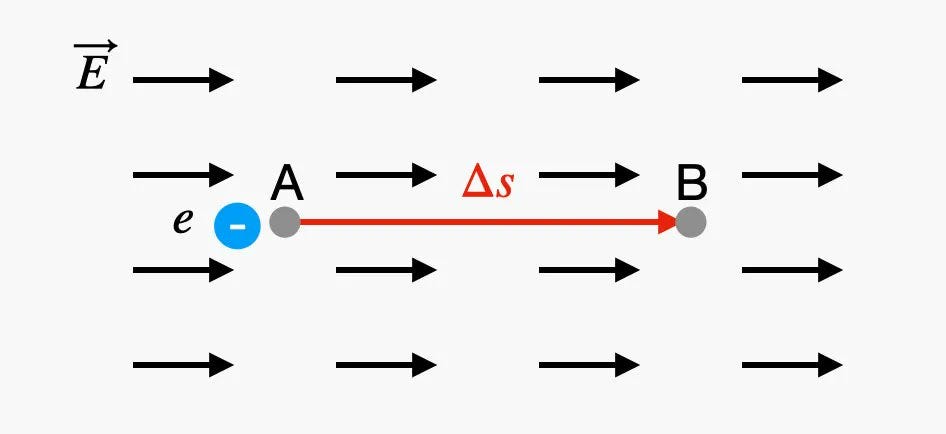
When you have an electric field, going “up” the field requires energy. However, going “across” the field (in this case, up and down vertically in the photo) takes ZERO energy.
The same for life. Going up or down levels is what requires energy. Going across levels takes much less.
Many of us are stuck in the paradigm of thinking laterally instead of thinking vertically.
Lateral thinking: I need to do these other things so that I can (x), (y), and (z).
Vertical thinking: I just need to reach the top of (x) domain and cover for my weaknesses.
Lateral thinking: I need to do all (x) activities, and get better at all of them
Vertical thinking: I'll get good at this one (x) activity, then move through the rest one-by-one.
This is a logistical curve. Your skill level / success in any one domain will start off a bit slow, pick up towards the middle, and then slow down as you get closer to the top.
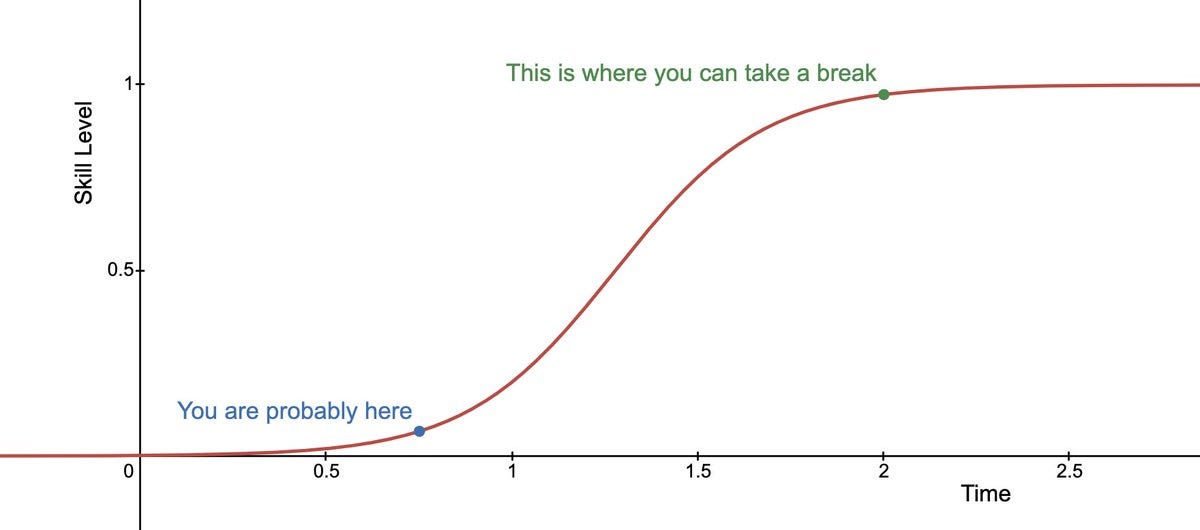
Once you reach the top part of the logistical curve, you can take a step back and fix all the other issues you've accumulated along the way.
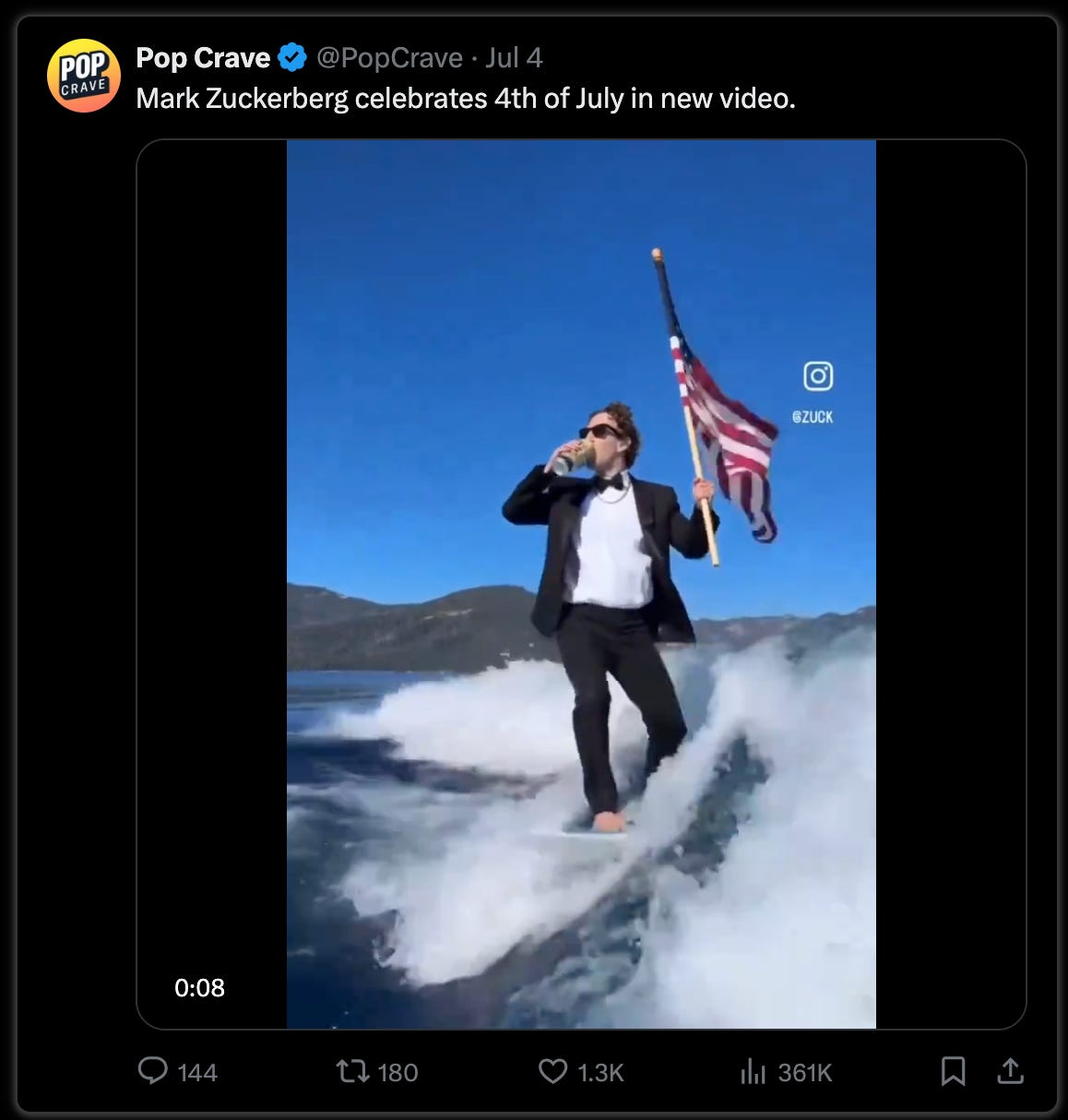
For example: Zuckerberg got really, really, REALLY good at the money game. Then he stepped back and became a healthy human again, and now wears Tuxedos while surfing and drinking a beer on the 4th of July.
Now that you understand why skill acquisition is so important, let's discuss how that actually happens: learning.
Learning vs. Knowing
Knowing comes from retaining knowledge. It is a passive process that is necessary but fundamentally not based on action. Knowing something is simply setting the stage so that learning can occur.
Learning is an active process of actually doing something and engraining those lessons into your subconscious.
Knowing is an a priori process and happens internally. Learning is an a posteriori process and happens externally.
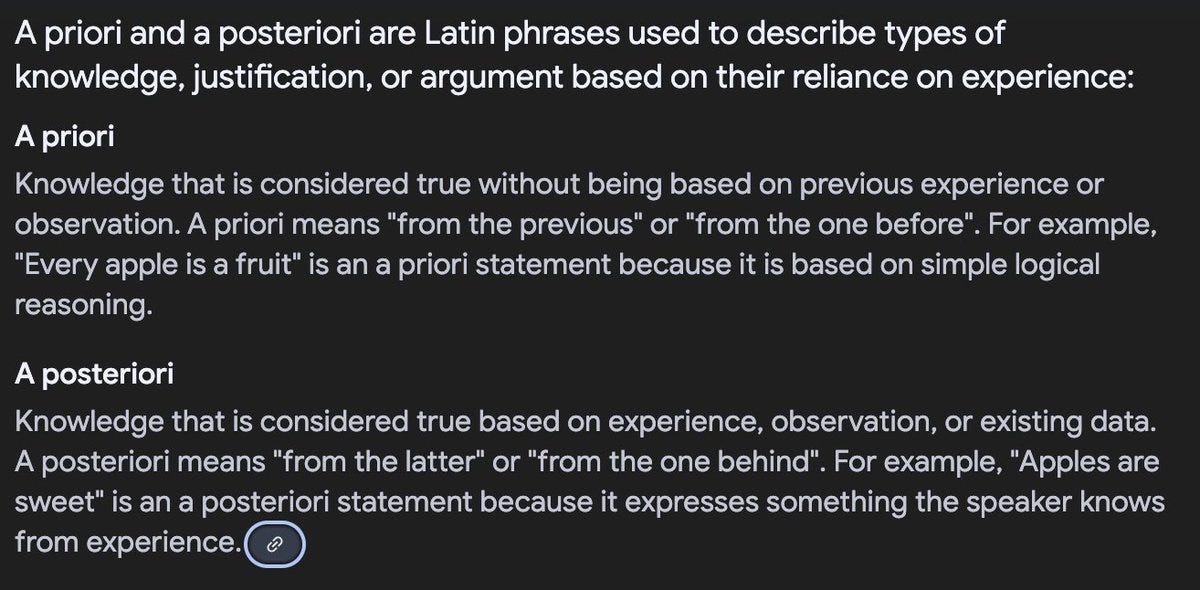
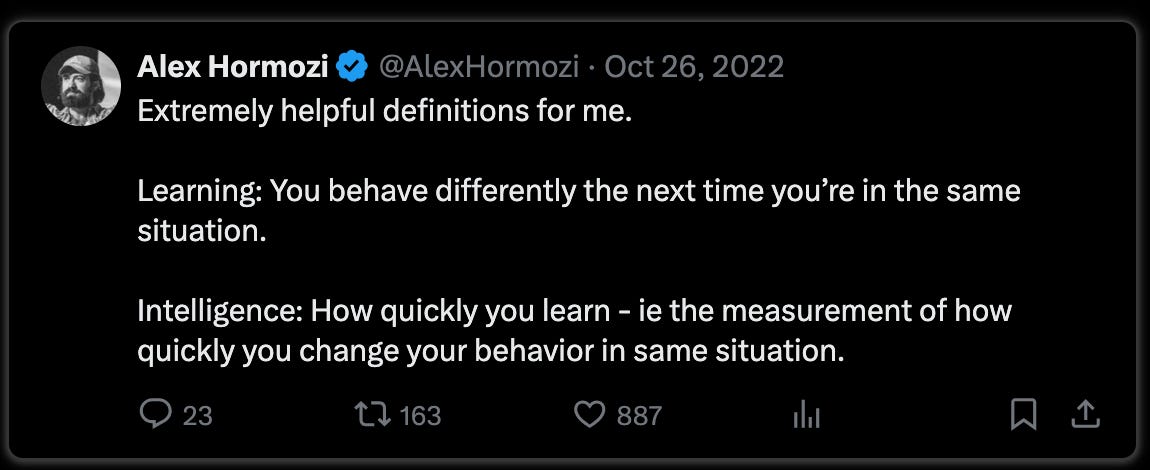
If you do not change your behavior, you have not learned.
You can know that you need to get more sleep, but you have not learned it until you actually do get more sleep and getting more sleep becomes part of your life.
You can know that you can't do alcohol and be maximally productive the next day, but you have not learned it until you turn down your friends invitation to go drinking on a Saturday night.
Action reveals everything that you have learned, not what you know. Just because you know that you should be doing a specific action doesn't mean you are better than the people who don't do it, until you actually start executing and changing your life.
Passive Knowledge
Everyone loves talking about passive income. Ways you can add cashflow without adding significant input time. Hence, income that is passive. This often takes the form of some sort of investing, whether its real estate, stocks, etc.
Sure, all that's great, but what else can be compounded without additional input? Knowledge. Learning is an active process. Knowing is a passive process. You know so that you can do.
We compound our money so that we can eventually cash out and spend it.
We get a base set of $$.
We put it into a specific vehicle
The $$ grows without you actively tending to the specific vehicle.
In the same way, we compound our knowledge so we can eventually take action and learn from it.
We get a base set of knowledge
We apply that knowledge in our lives, making connections and insights along the way
That knowledge grows without you actively attempting to know more.
For example: the fitness knowledge of how to diet.
Person 1 understands that calories in < calories out needs to occur to lose weight. So they do diet, but eat junk, highly processed food and wonder why they feel like shit.
Person 2 knows what Person 1 knows, and also understands that healthy, non-palatable foods maintain a good metabolism and therefore make the dieting process easier.
If Person 2 didn't know what Person 1 knew, their second piece of knowledge would be useless, but because they know the basics, the rest of their knowledge becomes significantly more useful.
This is the essence of compounding knowledge.
Individual pieces of knowledge becomes vastly more useful when you have more of it.
There is some barrier of knowing before you begin the process of learning. Most "big changes" anyone makes in their life have been brewing for a while.
It may seem like I've shitted on knowing a lot during the course of this article, but I believe it is necessary to know before you learn.
Issues only arise when:
You confuse knowing vs. learning, and end up never learning
You are unaware of the knowing vs. learning dynamic and take too much time between knowing and learning
So, here are the corresponding solutions:
Understand the difference between knowing vs. learning and prioritize each on their own
Spend less time between knowing and learning. Lower your barrier to action, and you can learn faster. Make yourself more intelligent. Who doesn't want to consider themselves intelligent?
Fake Truth and Testing Yourself
Many people I know believe themselves to have certain traits. We all do. But you do not have these traits until they have truly been tested.
You might not be introverted, you might just have no friends.
You might not be someone who doesn't do drugs or alcohol, maybe you just haven't been invited to any parties.
You might not be an endurance athlete, you might just be weak and suck at sprinting.
You might not be a "math guy", you might just have underdeveloped writing skills.
Test yourself. Think about the frames and traits that you've casted upon yourself and evaluate their truth. This is a specific example from my life lately:
I had always liked reading, but thought of myself as a computer science, general science, and math kid since elementary school. As I went through middle school, I liked science less and less, and as I went through high school, I liked math less and less.
Now in college, I honestly don't like CS specifically very much, even though I'm pretty good at it compared to those around me. However, I realized why I was drawn to CS. What I actually like is making sense of, ordering, and redefining the world around me.
Thats why I liked CS. It was a way to make sense and order the world in specific ways. What I don't like is the repetitiveness of it.
And this is how I view most "hard-skills". They are just manifestations of much deeper and general tendencies. No human 1000 years ago could even conceive or imagine what Fortnite or Netflix was. Yet many of us are drawn to these modern inventions because of our underlying, general predispositions.
So right now you're probably thinking: "no shit. so what?"
Look at what pursuits you love. Re-evaluate them. Do you truly love it, or the patterns associated with it?
This process of reflection does not just happen once in your life. You don't just wakeup one day, realize something isn't working for you, pivot, then live happily ever after in this new, perfect money vehicle that gives you everything you ever wanted.
Your life is an ongoing evolution of being directionally correct rather than absolutely correct.
For example: at my last position at work, I was a developer. I listened to what people told me to make, I made it, shipped it to clients, and did a few other things, but that's the gist of it. On the (navigator / manager / maker) continuum, I was a maker.
In my next position, I'm aiming to be more of a manager, to work with others more. I might overshoot it. It might turn out that I actually suck at talking to people, and I should stick to a more maker-type role. Thats ok. If that happens, I will probably adjust a little bit and go back to more of an analyst / account manager role thats somewhere in the middle of managing / making. If I end up being really good and want to manage more, I'll adjust and do that.
Choose a direction, go forward, re-evaluate, choose a new direction. You don't have to always be perfectly right. You just need to be more right than last time.
(this was initially written on my twitter and imported over here as I’m making the switch to substack)